DECEPTION UNMASKED: Marty Lagina Solves 220-Year Oak Island Enigma by Exposing Money Pit as Historic Engineering Misdirection

In a historic development that has permanently rewritten the narrative of the world’s longest-running treasure hunt, energy tycoon and engineer Marty Lagina has shattered the 220-year-old mystery of Oak Island. Long regarded as the Fellowship of the Dig’s uncompromising voice of scientific reason, Lagina has uncovered an un-excavated, bone-dry subterranean chamber on the island’s eastern flank. The breakthrough has yielded the original 18th-century construction blueprints, a detailed cargo inventory, and a handwritten ledger proving the existence of a $240 million royal French military vault.
For generations, treasure hunters have suffered catastrophic financial ruins and logistical failures hyper-focusing on the notorious Money Pit. By analyzing years of collected scanning data, topographical surveys, and water-flow maps over a single winter, Lagina approached the island not as a repository of folklore, but as a sophisticated piece of defensive military engineering. He deduced that the booby-trapped Money Pit was an elaborate, highly dramatic act of tactical misdirection designed to draw searchers into a permanent flooding loop, while the actual cache was hidden in an ordinary, easily overlooked sector.
Unearthing the 1762 French Sovereign Ledger
Acting on anomalies in local surface drainage patterns, Lagina directed a targeted, low-cost excavation on a modest eastern ridge. At a depth of 15 feet, heavy machinery struck meticulously shaped masonry blocks rather than natural bedrock. A slow, forensic excavation exposed an eight-foot-square stone structure engineered with advanced 18th-century stone-hewn channels designed to permanently divert groundwater away from the core chamber.
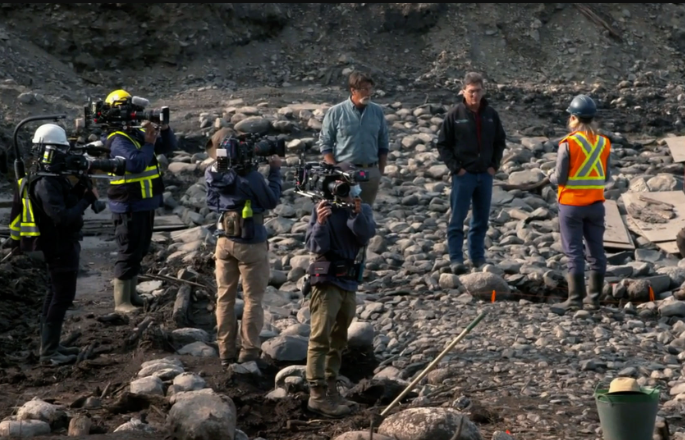
Inside the dry vault, crews recovered three pristine historical artifacts that successfully validated Lagina’s misdirection theory:
-
The Blueprint: A massive stone slab engraved with highly detailed engineering illustrations outlining the island’s entire underground network. Crucially, the graphics featured a precise, step-by-step bypass route that allowed the original builders to completely evade the active Atlantic flood tunnels.
-
The Construction Ledger: An intact lead container sealed with organic wax containing a meticulously handwritten French military document dated 1762. Translated on-site, the ledger names Jean-Baptiste, an elite engineer serving the French Crown, as the architect of the “protected island vault system.” The date aligns precisely with the chaotic final chapters of the Seven Years’ War, when French authorities scrambled to conceal colonial assets from advancing British forces.
-
The Manifest: A waterproof copper cylinder protecting a rolled parchment inventory. The document details an emergency military cache consisting of gold shipments from French colonial holdings, sacred religious relics evacuated from Quebec, and private aristocratic wealth. The total valuation, when converted from historic French livres to modern currency, approaches an astronomical $240 million.
Piercing the Vault at 140 Feet
To confirm the validity of the documents, the fellowship initiated deep ground-penetrating radar scans and exploratory drilling based entirely on the coordinates listed in the French blueprint. The technical surveys immediately confirmed a major, human-constructed void measuring 142 feet below the surface and situated exactly 200 feet away from the traditional Money Pit grid.
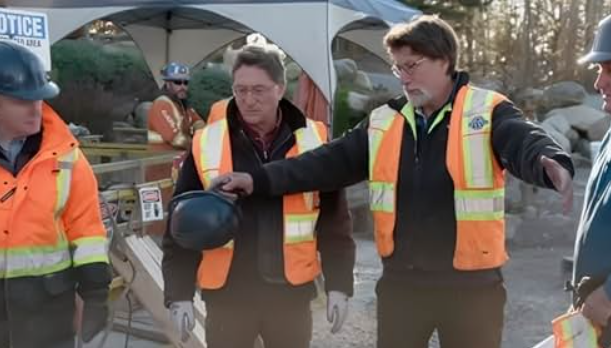
Utilizing precision directional drilling rigs to follow the blueprint’s exact mathematical bypass sequence, engineers successfully tunneled down to the chamber’s perimeter without triggering the island’s notorious booby traps. At the 140-foot mark, down-hole cameras captured a massive, sealed stone doorway matching the architectural schematics.
Upon executing the mechanical locking sequence detailed in Jean-Baptiste’s notes, the stone seal slowly shifted open, releasing compressed air that had remained trapped since the mid-18th century. Interior lighting rigs immediately illuminated rows of stacked military strongboxes, preserved iron-bound chests, and wrapped artifacts completely untouched by time or moisture.
Independent laboratory testing has already authenticated the paper, ink composition, and organic wax signatures as genuine colonial products of the 1760s. By replacing romantic speculation with clinical engineering analysis, the fellowship’s resident skeptic has successfully transformed a centuries-old maritime myth into an undeniable historical reality.