A precious gem has been discovered beneath Oak Island, potentially worth up to $2 million.
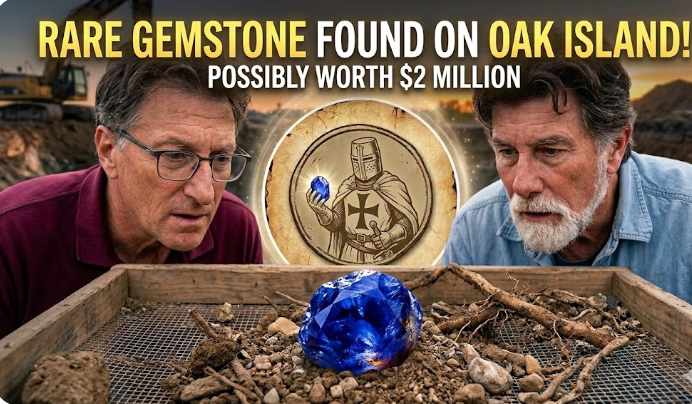
For more than two centuries, Oak Island has been associated with stories of hidden treasure, elaborate underground engineering, and the possibility that valuable artifacts were concealed beneath its soil long before modern searchers arrived. Now, a new discovery has captured the attention of both researchers and viewers of The Curse of Oak Island: a precious gemstone reportedly found beneath the island that could be worth as much as $2 million.
While the exact details surrounding the gem are still being studied, the potential implications of such a discovery could reshape how investigators interpret the island’s long and complex history. From an analytical standpoint, the question is not simply about the value of the gemstone. The far more important question is how such an object arrived on Oak Island in the first place.
Why a Gemstone Matters More Than Its Price
At first glance, the discovery of a gemstone may appear to be just another artifact uncovered during excavation. But within the context of Oak Island, even a single object can dramatically alter the direction of the investigation.
A gemstone of high value suggests wealth, trade, or ceremonial importance. Unlike everyday objects such as nails, tools, or ship fragments, a precious stone would almost certainly have been part of something meaningful—perhaps jewelry, a ceremonial item, or a container of valuables.
If the stone truly dates back several centuries, its presence could strengthen the theory that Oak Island was used as a storage site for high-value goods rather than simply a temporary landing area for travelers.
The Lagina brothers and their team have already uncovered objects connected to different historical periods: trade beads, buttons linked to European military uniforms, medieval-style artifacts, and even Roman coins that sparked debate about early transatlantic travel.
A gemstone adds another layer to that pattern.

Possible Historical Origins
From a historian’s perspective, there are several plausible scenarios that could explain the presence of a valuable gem on Oak Island.
One possibility is that the gemstone was part of European aristocratic jewelry transported across the Atlantic during the Age of Exploration. During the 16th and 17th centuries, European powers routinely moved valuable goods between continents. Ships carried gold, silver, gemstones, and religious artifacts as part of both trade and colonial expansion.
If such cargo were at risk of being seized by rivals or pirates, hiding it in a remote location would not have been unthinkable.
Another theory ties the discovery to the long-discussed Knights Templar or Knights of Malta connections. While these theories remain controversial, artifacts found on the island—including religious symbols and European trade objects—have fueled speculation that a secretive group may have used Oak Island to store valuable items.
A gemstone of significant value could align with that idea.
Finally, the gem could simply be part of a personal object lost or discarded by someone who visited the island centuries ago. Sailors, merchants, and explorers often carried jewelry and trade goods.
However, the deeper the object is found, the less likely it becomes that it was casually dropped.
The Importance of Context
One of the most critical elements in evaluating the gemstone will be its archaeological context.
Where exactly was it found? Was it near wooden structures, metal artifacts, or other materials that could be dated? Was it recovered from undisturbed ground, or from spoil piles created during previous excavation?
These questions will determine whether the gem represents an isolated curiosity or part of a larger pattern.
If the stone was discovered near engineered structures such as tunnels, shafts, or stone pathways—features the Oak Island team has increasingly documented—then the discovery could point toward a coordinated effort to store valuable items underground.
In other words, the gem might not be the treasure itself but rather a clue pointing toward something much larger.
What the Discovery Could Lead To
If the gemstone’s origin can be verified, several developments could follow.
First, researchers may attempt to identify where the gem was originally mined. Many gemstones have unique geological signatures that allow experts to determine their source regions. If the stone originated in Asia, South America, or Europe, that information could reveal trade routes connected to Oak Island centuries ago.
Second, the team may search for additional objects in the same area. Valuable artifacts rarely exist alone. If the gem was part of jewelry, for example, fragments of metal settings or other decorative pieces might still be nearby.
Third, the discovery could influence the direction of ongoing drilling and excavation. The Lagina brothers’ strategy often focuses on identifying clusters of clues rather than relying on a single artifact.
A gemstone discovery could redirect attention toward areas previously considered less important.

A Turning Point for the Investigation?
In many ways, the Oak Island mystery has always been about patterns.
Each new artifact—whether a coin, a carved piece of wood, or a fragment of metal—adds another data point to a puzzle that spans centuries.
A gemstone valued at millions of dollars would certainly be one of the most striking discoveries yet.
However, seasoned investigators know that the real value lies not in the object itself but in the story it tells.
If the gem can be connected to a specific historical period or group of visitors, it may help answer one of the island’s oldest questions: who built the elaborate structures beneath Oak Island—and why?
Looking Ahead
As laboratory testing continues and the team examines the circumstances surrounding the discovery, viewers of The Curse of Oak Island will undoubtedly be watching closely.
For analysts of the show and its ongoing investigation, the gemstone represents more than just a valuable find.
It is another piece of evidence suggesting that Oak Island may have served as a staging ground for events far more complex than anyone imagined when the search first began over 200 years ago.
Whether the gem proves to be a standalone artifact or the first sign of something larger, one thing remains certain: Oak Island’s story is still unfolding—and discoveries like this ensure that the mystery is far from over.