Oak Island Team Uncovers Man-Made Stone Structure That May Redefine the Long-Running Mystery

For more than 200 years, Oak Island has drawn explorers, historians, and engineers seeking answers to one of North America’s most enduring legends. Despite countless excavations, advanced equipment, and significant investment, the island’s central mystery has resisted clear explanation. In 2025, however, a new phase of exploration has brought the Lagina brothers and their team closer than ever to understanding what lies beneath the surface.
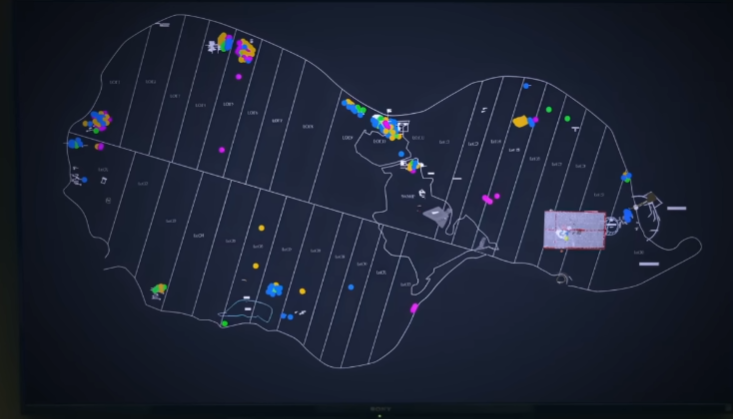
This season, Rick and Marty Lagina shifted their focus to an area that had received comparatively little attention in the past: the land between Lot 5 and Lot 9. While earlier efforts concentrated on the Money Pit and surrounding features, recent data suggested that this overlooked zone might hold critical clues. Satellite imagery, ground-penetrating radar, and three-dimensional mapping revealed a flat, linear anomaly beneath the soil—one that did not match typical geological formations.
Using a careful, methodical approach, the team began excavation without heavy machinery, removing layers slowly to preserve anything hidden below. Almost immediately, they encountered soil conditions and structural elements that differed from surrounding areas. Wood fragments, stone alignments, and compacted layers hinted at deliberate human activity rather than natural processes.
The defining moment came when excavation tools struck a solid, flat surface that produced a sound inconsistent with bedrock. As the area was cleaned by hand, a smooth stone face emerged, marked by straight edges and uniform lines. Further exposure revealed a corner—suggesting the wall of a constructed space rather than a random rock formation.
Experts on site quickly noted the precision of the stonework. The blocks appeared to be of consistent size, set in orderly rows with evenly spaced joints. Such regularity, archaeologists noted, is rarely found in nature. Tool marks visible on the stone surface further reinforced the conclusion that the structure was shaped intentionally.
As the team expanded the excavation, a narrow gap was discovered along one section of the wall. A fiber-optic camera was carefully inserted, revealing a narrow passage with flat walls supported by wooden beams. The design resembled early tunnel construction methods, and the wood appeared heavily aged. Preliminary estimates suggested it could date back several centuries.
In addition to the tunnel, investigators documented markings etched into the stone. While some appeared to be tool impressions, others resembled symbolic carvings, including cross-like forms and linear characters. High-resolution images were sent to specialists in historical symbols and ancient scripts for further analysis. Early assessments indicated that some markings may resemble medieval European iconography, though definitive conclusions have not yet been reached.
Wooden fragments recovered nearby added further complexity to the discovery. Some pieces appeared to be parts of structural supports or access features, such as stairs or door frames. Several showed signs of burning, raising questions about the use of fire within the structure. Laboratory testing is now underway to determine their age and origin.
The engineering of the site also drew attention. Stone joints appeared tightly fitted, limiting water infiltration—an important consideration on an island surrounded by groundwater. Soil layers above the structure differed from native deposits, suggesting that material may have been transported deliberately to conceal what lay below. In some samples, coconut fiber was identified, a material not native to the region, indicating contact with distant trade networks.
Rick Lagina described the find as fundamentally different from previous discoveries. Unlike isolated artifacts or scattered features, the structure appeared integrated and purposeful. Marty Lagina, often the project’s most cautious voice, acknowledged that the scale and quality of the construction surpassed anything previously uncovered on the island.
Team members echoed this sentiment. Jack Begley noted that the structure’s solidity and planning suggested long-term intent. Metal detection expert Gary Drayton emphasized that such an effort would only be undertaken to protect something of significant importance—whether material, historical, or informational.
The discovery has also revived long-standing theories surrounding Oak Island’s past. Some researchers point to medieval orders, including the Knights Templar, whose symbols have been associated with earlier island finds. Others suggest links to early European or colonial engineering practices, or even cooperative efforts between multiple groups across centuries. At this stage, the team remains cautious, emphasizing evidence over speculation.
Excavation has temporarily paused while samples undergo carbon dating, material analysis, and epigraphic study. Structural assessments are also being conducted to ensure safety before any further entry into the tunnel. In parallel, heritage authorities have shown increased interest, and discussions are underway regarding the site’s potential historical designation.
What lies beyond the newly discovered passage remains unknown. Whether it leads to a chamber, connects to other known features, or represents part of a larger system has yet to be determined. What is clear, however, is that the find represents a turning point in the search—shifting the narrative from scattered clues to a coherent, constructed environment.
After generations of effort, Oak Island may finally be revealing not just isolated artifacts, but the framework of a larger story. As research continues, the team hopes that science, patience, and careful analysis will bring long-sought answers closer to the surface.