Is Oak Island Hiding More Than Just Gold? Discovery of Ancient Roman Artifacts!

For centuries, Oak Island has captivated treasure hunters, historians, and curious onlookers with its tantalizing promise of hidden riches. Legends suggest that everything from pirate treasure to the secrets of the Knights Templar might be buried beneath its soil. Yet, a recent discovery has sent shockwaves through the Oak Island team and the public alike: evidence suggesting that the Romans might have once set foot on this mysterious island in North America. If confirmed, this revelation would rewrite history and forever alter the narrative of early exploration in the Americas.
The island, located off the coast of Nova Scotia, has been a focal point for treasure hunters since the late 18th century, but it wasn’t until the Gold Rush-style reality TV show The Curse of Oak Island that the world became fully aware of the bizarre and seemingly inexplicable artifacts found beneath its surface. From gold chains to ancient coins, each new discovery deepens the enigma. However, it wasn’t until recently that a team of divers, led by the Lagina brothers, made an extraordinary find that could change everything.
A Daring Dive Leads to New Discoveries
The find that has set tongues wagging began with a near-disastrous dive into Borehole 10X. For decades, treasure hunters have suspected that this dangerous, water-filled shaft might hold the key to unlocking the island’s mysteries. The shaft, which drops 235 feet deep, narrows into a tight, submerged tunnel, and over the years, it has claimed its share of lost equipment and near-fatal accidents. This time, however, the Lagina brothers called in professional divers Harvey Morash and Michael Gharts to explore the site.
As they descended into the murky depths, communication systems failed, and panic set in. For 32 minutes, the team on the surface had no idea if the divers were safe. Eventually, a light appeared from the depths, and the crew breathed a sigh of relief. While Morash was able to make it down the shaft, the visibility was almost non-existent due to thick clouds of silt, and he was forced to retreat. Despite discovering various pieces of debris, old wooden structures, and rocks, Morash could not locate the legendary treasure chamber—nor did he uncover any conclusive evidence of its existence.
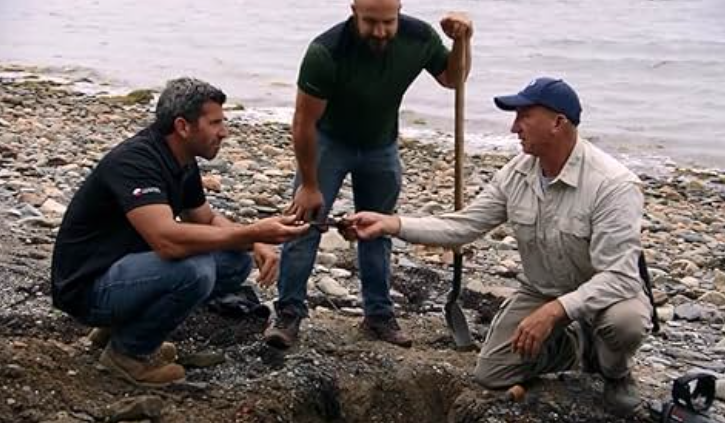
The dive ended in disappointment, but it also shifted the team’s focus to a new lead. While exploring another area of the island, the team uncovered what appeared to be an ordinary rusted metal piece. Upon further investigation, they realized it was a well-crafted pulley—a mechanism likely used for lifting heavy objects or perhaps even operating secret trap doors. As exciting as the pulley was, it wasn’t the most groundbreaking discovery that day. That came when Charles Barkhouse, a key member of the team, presented a Roman sword—an artifact that had the potential to upend everything we know about early transatlantic history.

The Roman Sword and the Question of Early Transatlantic Travel
The Roman sword had been passed down through generations of a local family who had found it while illegally scalloping near Mahon Bay, just off the coast of Oak Island. Though it had been kept a secret for decades, the artifact eventually found its way into the hands of the Oak Island team. What made the sword so extraordinary was its distinct hilt, which featured a carving of Hercules—an emblem commonly associated with Roman military decorations. While the sword’s ornate design immediately caught the attention of experts, what truly made the find remarkable was the fact that such an artifact had no business being on an island off the coast of Canada.
Roman civilization, as we know it, had no known presence in North America. Their empire spanned Europe, the Middle East, and parts of North Africa, but the idea that the Romans could have ventured across the Atlantic to North America has been dismissed by mainstream historians. The sword’s discovery, however, has reignited the debate over early transatlantic travel. Some believe the sword could be proof that Romans—or at least people of Roman origin—made it to the New World long before Columbus. Others are more skeptical, suggesting the sword could have been brought to Oak Island at a later time, perhaps through trade or as part of an elaborate hoax.
To settle the debate, the sword was sent to St. Mary’s University in Halifax, where specialists in archaeology and metallurgy analyzed it. Initial tests revealed that the sword’s metal composition—copper, tin, lead, and traces of arsenic—matched Roman bronze. However, a critical flaw in the sword’s casting technique raised doubts. The sword appeared to have been cast in a by-valve mold, a method not typically used by Roman blacksmiths. This anomaly suggested that the sword may have been made much later, possibly in the medieval or early modern period. Further tests showed high levels of zinc in the sword, a metal not commonly found in ancient Roman alloys. This raised the possibility that the sword was a modern replica, inspired by Roman designs, rather than a genuine artifact from antiquity.
Despite the inconclusive results, the debate over the sword’s authenticity continues. Some experts suggest the sword could be an antique inspired by Roman artifacts, while others argue that its discovery near Oak Island could indicate something far more significant—that the Romans were indeed here, long before anyone had suspected.
The Bigger Picture: Oak Island’s Unsolved Mysteries
This latest discovery only adds to the ever-growing list of mysteries surrounding Oak Island. Over the years, treasure hunters have unearthed a variety of strange and seemingly out-of-place artifacts, including Roman-style crossbow bolts, an inscribed stone, and even a lead cross thought to be linked to the Knights Templar. Some believe these discoveries are evidence of ancient visitors who came to Oak Island long before Columbus or the Vikings. Others argue that the artifacts are simply relics of later explorers or collectors who sought to add to the island’s legend.
Whether or not the Romans ever set foot on Oak Island is still up for debate, but one thing is clear: the island continues to surprise, confound, and captivate those who dare to uncover its secrets. From treasure hunters to historians, Oak Island’s bizarre artifacts and unexplained structures keep fueling the imagination and sparking new theories.
The idea that the Romans might have been in North America hundreds of years before Columbus is a controversial and fascinating proposition, but as Oak Island continues to yield new discoveries, it’s becoming increasingly clear that this island’s secrets—whatever they may be—are far from fully revealed. As the search for treasure continues, so too does the search for answers to one of history’s greatest mysteries. Will Oak Island’s secrets ever be fully unlocked? Only time will tell.