THE GUARDIAN’S SECRET: LAGINA TEAM UNEARTHS $98M TEMPLAR VAULT AND “BYZANTINE” CHALICE

In a discovery that has effectively “ruined” everything previously assumed about the Oak Island mystery, Rick and Marty Lagina have confirmed the location of a sealed, engineered vault 180 feet beneath the island’s swamp. Valued at an estimated $98 million, the find is being described not as a treasure hoard, but as a “containment site” for artifacts that prove a Knights Templar presence in North America centuries before Christopher Columbus.
The “Anomalous” Chamber
The breakthrough occurred following sonar mapping that identified a void cut directly into the bedrock, far below any known 18th-century excavation limits. Upon breaching the outer seal, the team recovered a limestone slab etched with a Cross Pattée—the unmistakable sigil of the medieval Knights Templar.
Carbon dating and erosion analysis suggest the tablet predates colonial settlement by hundreds of years. Most striking was the use of ancient marine clay as a sealant, a sophisticated technique used to prevent saltwater corrosion. “This is the first physical link to a Templar migration right here on Oak Island,” Marty Lagina stated. “It’s no longer abstract. It’s literal.”
The “Ghost” Map of La Rochelle
The archaeological find was bolstered by a startling discovery in the French naval archives at La Rochelle. Researchers located a 1701 chart titled Le’il Peru (The Island of Lost Gold). When corrected for centuries of magnetic shift, the coordinates align perfectly with Oak Island. Marginalia on the map, written in coded Latin and Old French, references L’ara du Tmple (The Temple’s Coffers) and warns of engineered “trapstones” designed to collapse if the vault is disturbed.
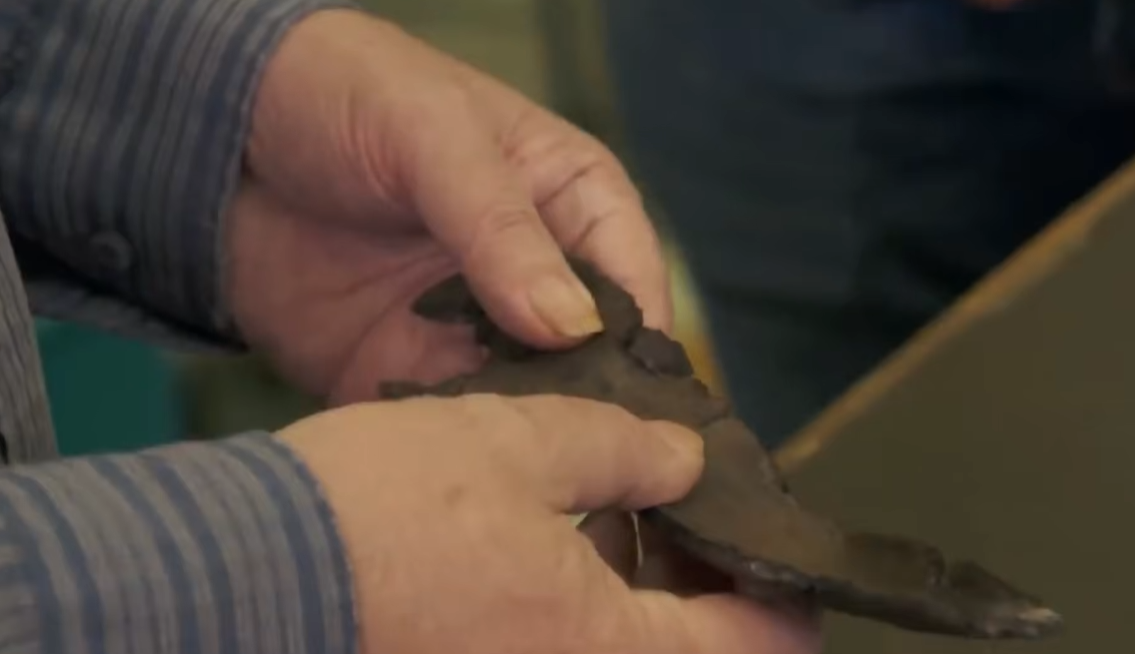
Historians now believe the site was the final destination for La Rochelle’s Ghost, a Templar ship rumored to have vanished during the 1307 purge by the French Crown.
[Image: A high-resolution scan of the 13th-century French brass chain recovered from the limestone.]
Nautical Engineering Underground
As the team pushed deeper, they encountered what they have termed the “Guardian Mechanism.” Rather than simple stone walls, the vault is protected by a wooden and brass lattice interwoven into the bedrock. This mechanical web uses a series of counterweights, pulleys, and water valves mirrored after 14th-century ship rigging.
“We’re not looking at a vault meant to be discovered,” Rick Lagina observed. “This is one engineered to self-destruct.” This nautical architecture suggests the builders were seafaring knights who applied shipboard technology to subterranean defense.
The Rose and the Chalice
The investigation reached its climax at a gleaming limestone archway adorned with the Rose Cross—a symbol of the Rosicrucians, the spiritual successors to the Templars. Beyond this gateway, magnetic sensors detected a massive, consolidated metallic mass.

Using fiber-optic probes, the team caught the first glimpse of the “Inner Sanctum.” Centered on a limestone pedestal stood an elaborate chalice. Subsequent laboratory analysis revealed the artifact is forged from a unique blend of Byzantine gold and Frankish silver, a metallurgical signature unseen since the 12th century.
The interior rim bears the Latin inscription: Veritas sub rosa (Truth beneath the rose).
Vatican Intervention
The discovery has triggered an immediate international response. Representatives from the Vatican’s Sacred Antiquities Department have reportedly arrived in Nova Scotia to oversee the handling of the chalice. For the Lagina brothers, the $98 million valuation of the gold is secondary to the historical revelation: Oak Island was never about pirates; it was a sanctuary for the “Divine Knowledge” of a fallen order.